
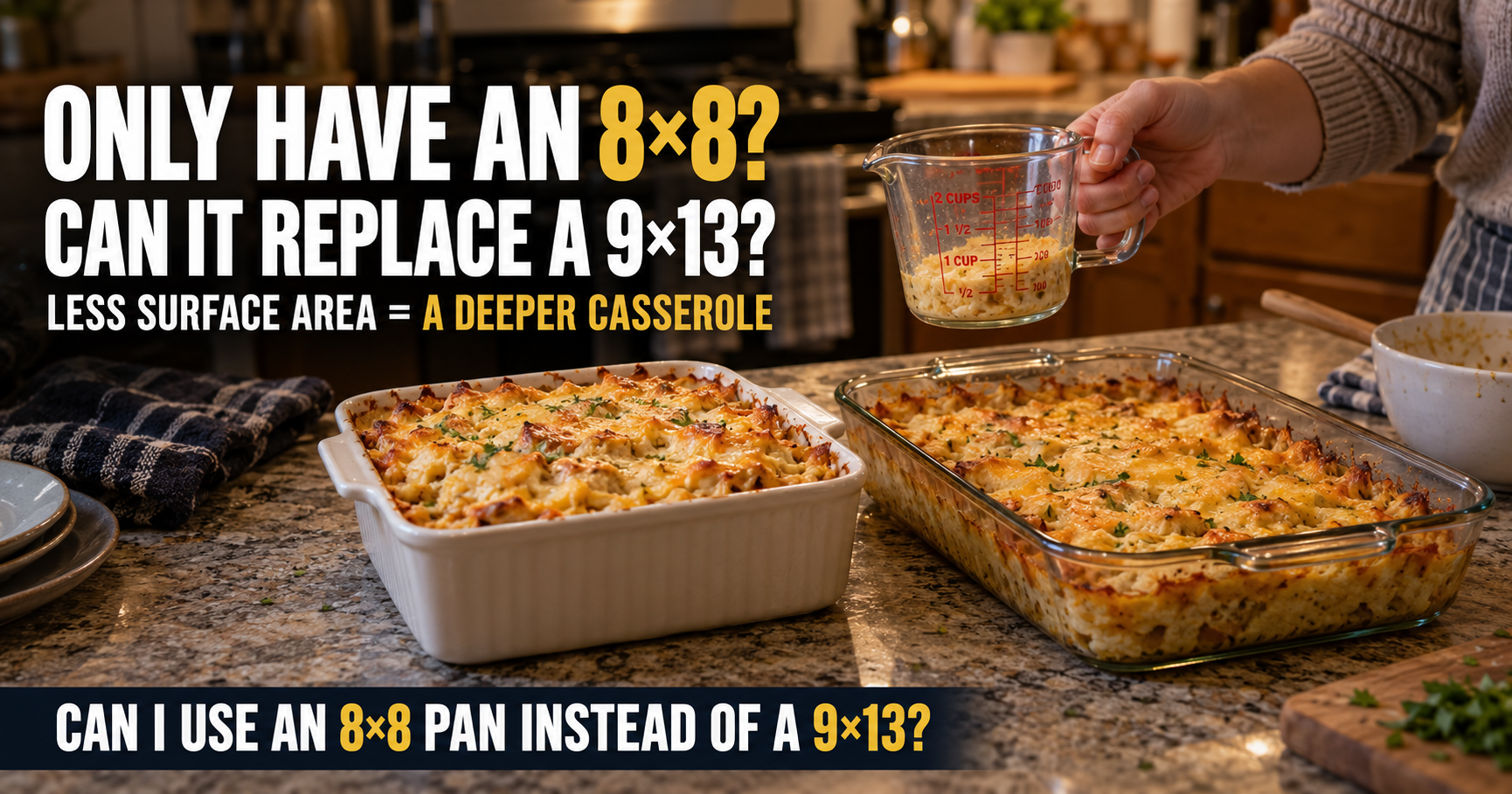
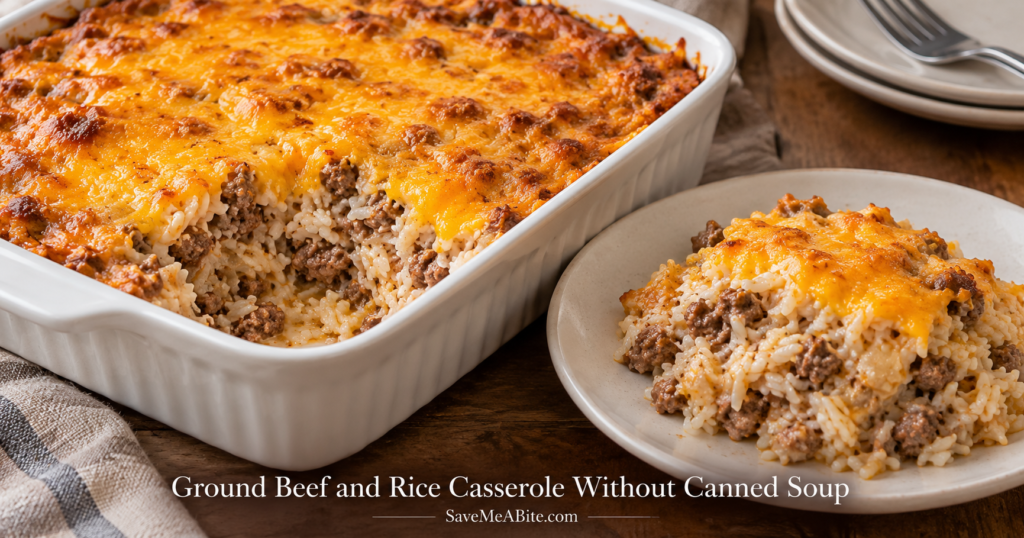
Yes, you can often use an 8×8-inch pan instead of a 9×13-inch pan for a casserole, if you reduce the recipe. For many casseroles, making half the recipe is a practical starting point. Putting the entire batch into the smaller dish is a different situation, and I would not assume it will fit or bake properly. A concrete example is this 8×8 ground beef casserole, which is written for the smaller baking dish.
The important part is keeping the filling at a reasonable depth. A smaller pan does not automatically mean a much shorter baking time, especially when the casserole is still just as thick.
My Starting Point Is Half the Recipe
If a casserole is written for a 9×13-inch dish and I want to adapt it for an 8×8, I start by looking at whether the ingredients can be cut in half without changing the cooking method.
That means halving the meat, rice or noodles, sauce ingredients, vegetables, and topping together.
I would not cut the meat and pasta in half but keep all the milk and broth. That changes the balance of the dish and can leave you with far more sauce than the smaller amount of food needs.
An 8×8 is slightly larger than half a 9×13 by surface area. King Arthur Baking also identifies that relationship in its pan-size guidance. That makes half a recipe a useful starting point, although pan depth and the particular recipe still matter.
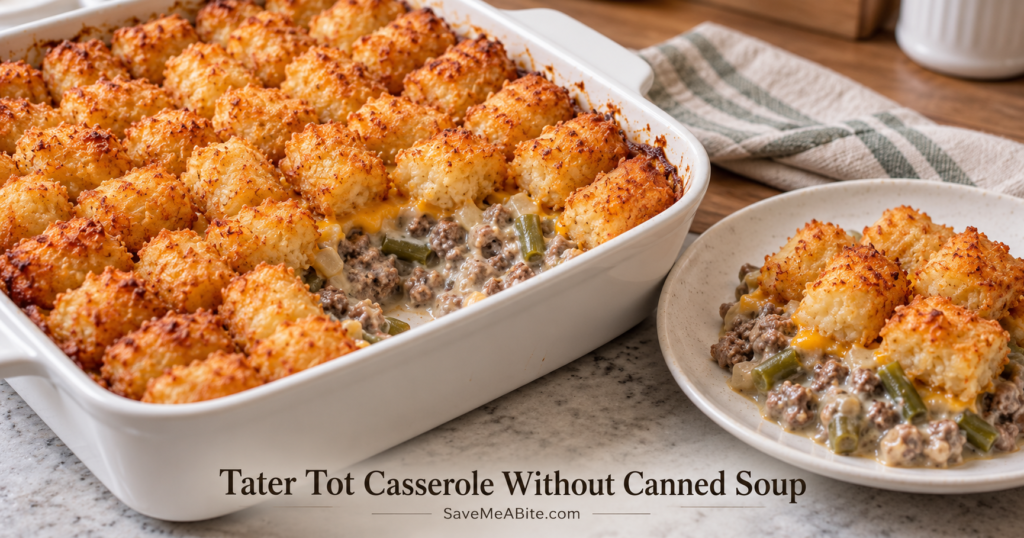
If you would rather skip the conversion, our 8×8 tater tot casserole without canned soup is already written around the smaller dish.
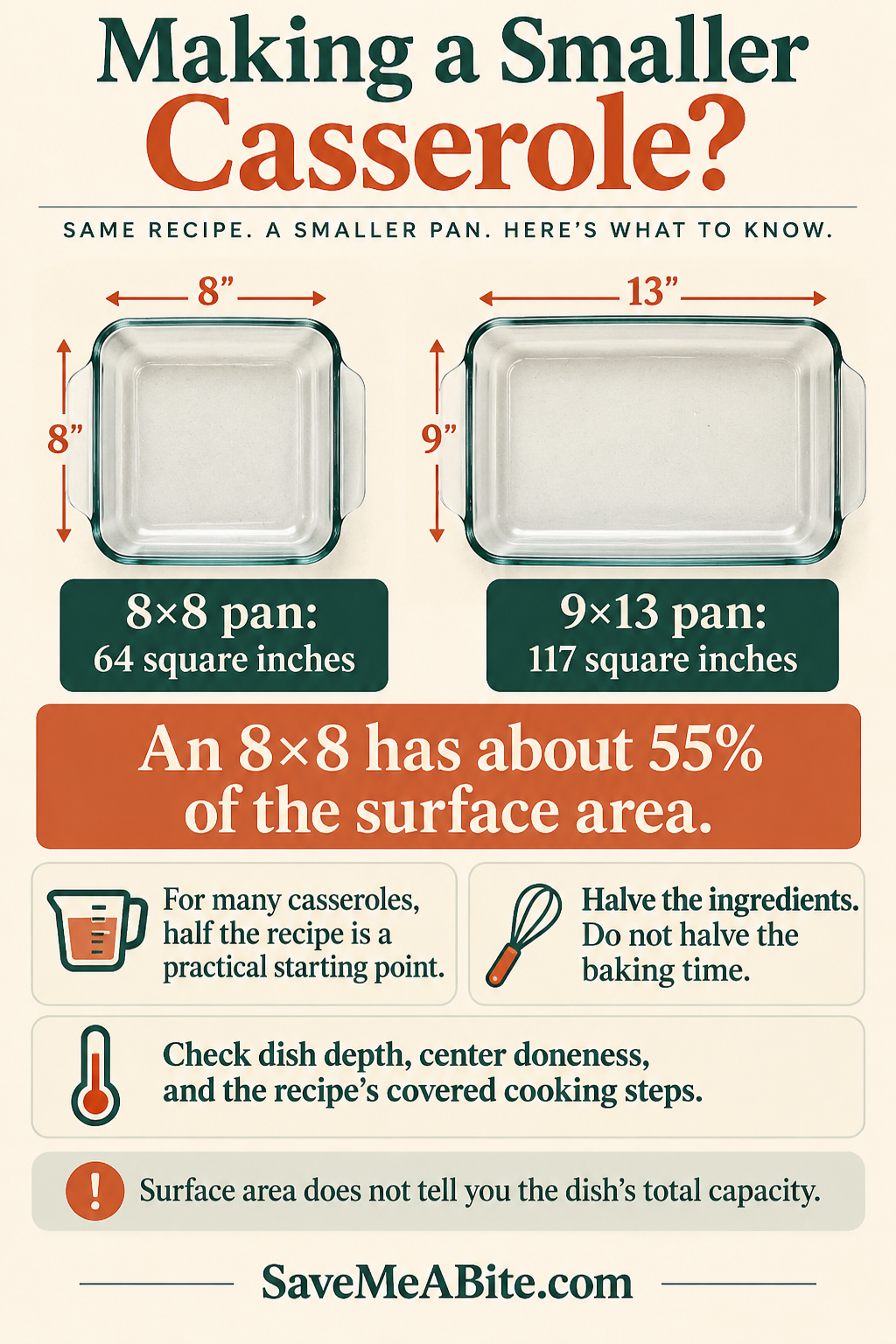
An 8×8 Pan Is About 55% of a 9×13
Here is the useful math:
8 × 8 = 64 square inches
9 × 13 = 117 square inches
64 ÷ 117 = about 0.55
That means the smaller pan has about 55% of the larger pan’s surface area.
For a similar filling depth, you would theoretically use about 55% of the original mixture. In an everyday casserole, making half is usually easier than measuring 55% of every ingredient.
With half the mixture in an 8×8, the filling will be slightly shallower than the full mixture would be in a comparable 9×13. That difference is often manageable, but it is another reason to check the dish instead of treating the original baking time as a guarantee.
Surface Area Is Different From Capacity
The math above compares the footprint of the pans. It does not tell you how much food either dish can hold.
A deep 8×8 casserole dish and a shallow 8×8 cake pan have similar footprints but different capacities.
Rounded corners, sloped sides, and actual interior dimensions also affect usable space. The dimensions printed on a dish may not perfectly describe its flat cooking area.
I use the area calculation to judge the recipe amount, then check the actual dish before filling it.
Can You Put the Whole 9×13 Recipe in an 8×8?
Sometimes a small recipe might physically fit in a deep 8×8 dish. That does not make it a dependable swap.
Using the entire mixture in a pan with roughly half the footprint makes the casserole much deeper. The middle can take longer to heat while the edges and topping continue cooking.
You may end up with browned cheese over a center that still needs time, or dry noodles around the edges while the middle stays loose.
There is also the simple problem of bubbling. A dish filled nearly to the rim leaves little room for the sauce to move as it heats.
My recommendation is to reduce the recipe or divide it between suitable dishes. I would not pack everything into the smaller pan just because the last spoonful technically fits.
What if the Casserole Is Already Mixed?
If you have already prepared the full batch, divide it between two appropriately sized baking dishes when practical.
For a mixed casserole, distribute the solids and sauce evenly. Otherwise, one dish can end up heavy on noodles while the other gets most of the liquid.
For a layered casserole, divide the components as you build the layers. Keep their order and approximate thickness consistent.
Check each dish separately during baking. Two dishes are not guaranteed to finish at exactly the same time.
Do You Cut the Baking Time in Half?
No. Halving the recipe does not mean halving the baking time.
A casserole still needs time for heat to reach the center. If the smaller batch has a similar depth, that part of the process may remain fairly similar.
The starting temperature matters too. A freshly assembled casserole with warm ingredients behaves differently from one that has spent several hours in the refrigerator.
For a straightforward casserole made with cooked ingredients, I would keep the recipe’s temperature and begin checking before the original finish time. Checking five to ten minutes early is a reasonable starting approach, rather than a promise that the dish will be done early.
Look for the recipe’s actual doneness cues. Follow its food-temperature guidance when applicable, and check the center instead of relying only on the topping.
Keep the Covered and Uncovered Stages
If the original recipe calls for covered baking followed by uncovered baking, preserve that sequence unless the recipe provides a smaller-batch variation.
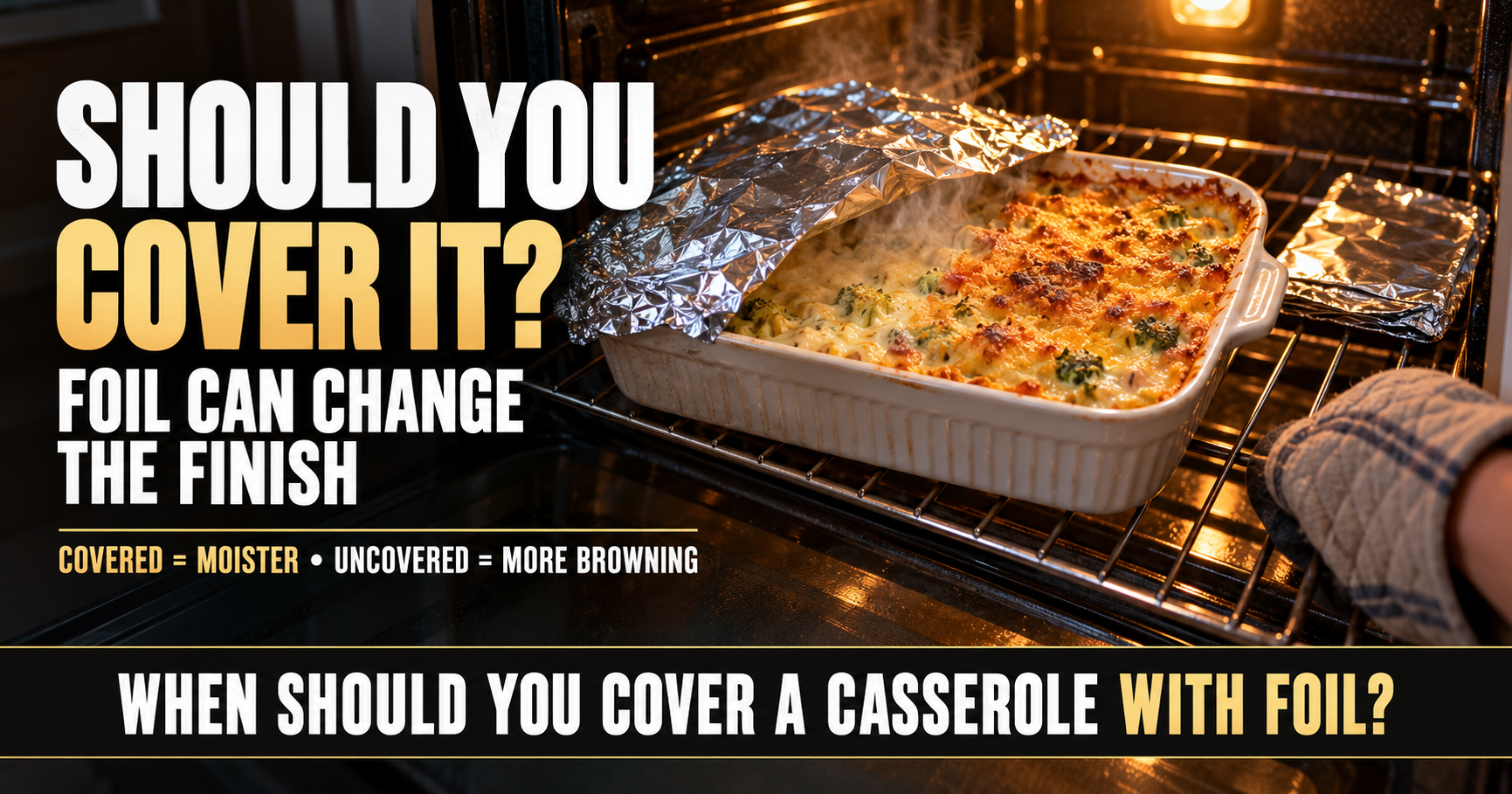
The covered stage may help ingredients cook through without drying out. The uncovered stage may allow moisture to escape or help a topping brown. Those two baking stages are explained in more detail in when to cover a casserole, including how foil affects moisture and browning.
Removing the foil much earlier just because the pan is smaller can change the result.
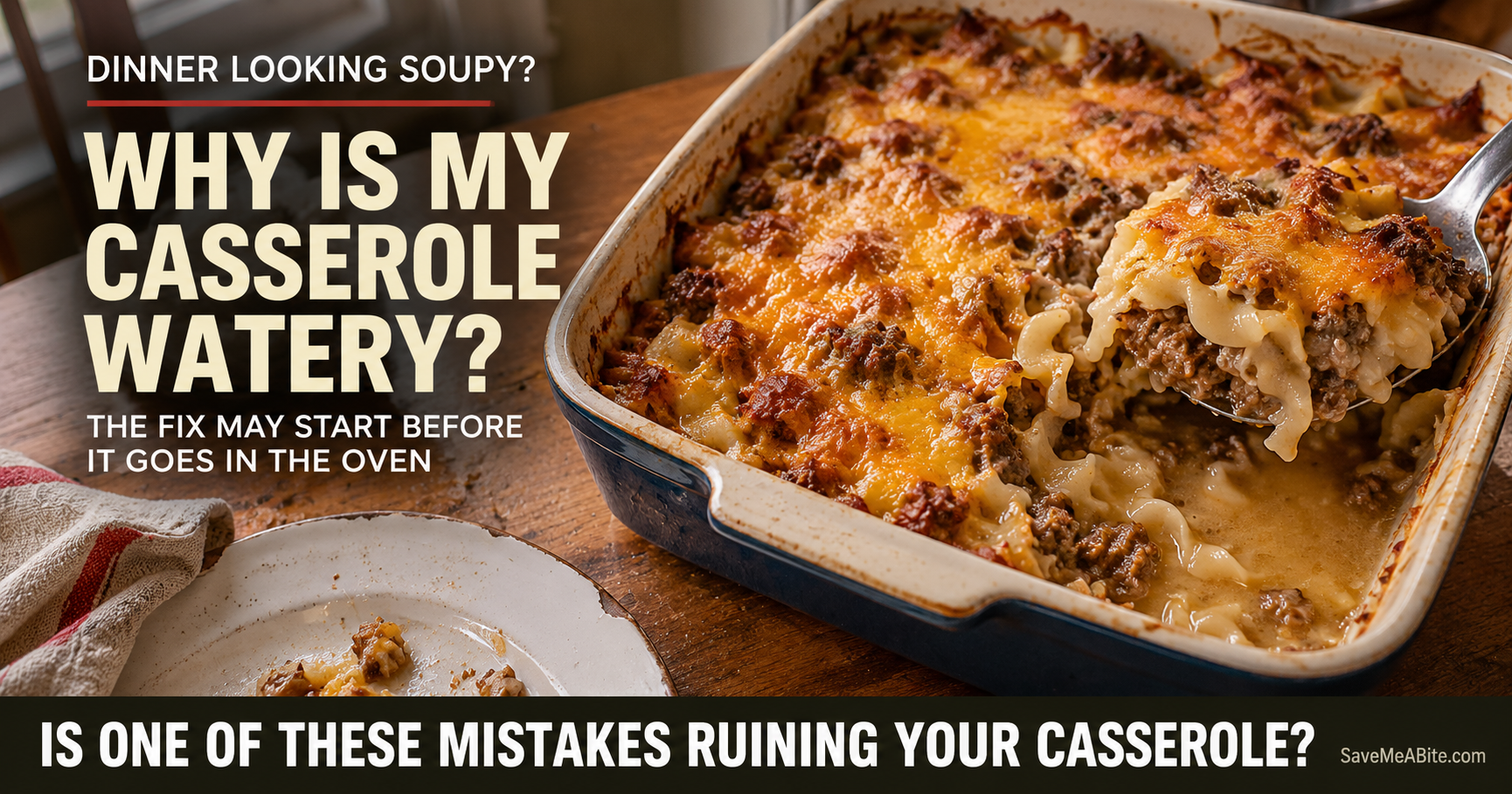
If the center is done but the filling is still too loose, our guide to fixing a watery casserole explains how to separate a moisture problem from an unfinished cooking problem.
How I Would Halve the Ingredients
I would work through the ingredient list before cooking, rather than try to divide a partially assembled casserole by eye.
For common measurements, the conversions are straightforward:
- One pound of ground beef becomes eight ounces.
- Two cups of cooked rice become one cup.
- Eight ounces of dry pasta become four ounces.
- One cup of milk becomes half a cup.
- Half a cup of broth becomes one-quarter cup.
- Two tablespoons of flour become one tablespoon.
- One tablespoon of butter becomes one and a half teaspoons.
- One teaspoon of seasoning becomes half a teaspoon.
The preparation details stay the same. Half a measurement does not change “cooked” to “dry,” or “drained” to “undrained.”
Halve the Sauce Ingredients Together
For a flour-thickened sauce, reduce the butter, flour, and liquids together.
Cutting the flour in half while keeping all the liquid produces a different sauce. Cutting only the liquid can make it much thicker than intended.
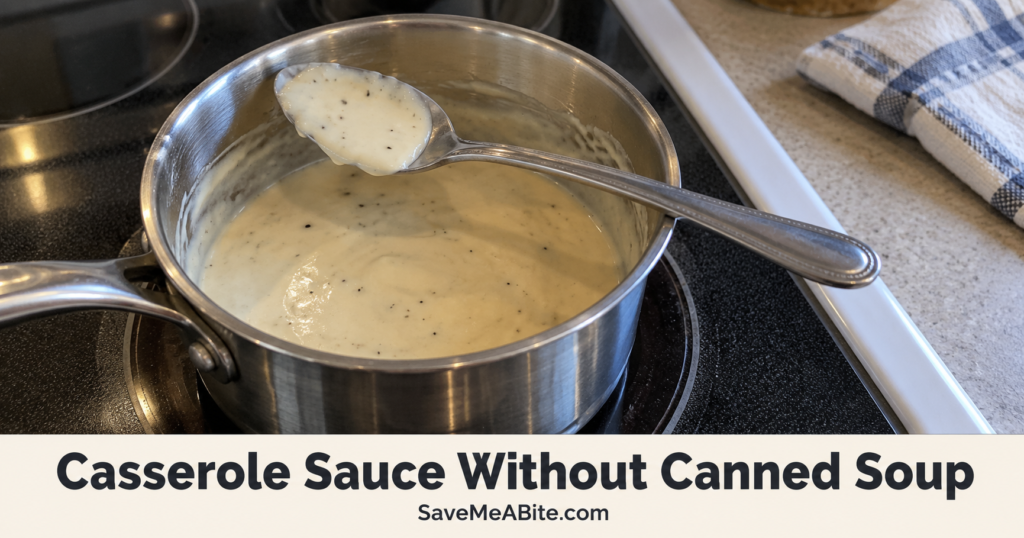
I would make the smaller quantity of sauce in an appropriately sized saucepan, then judge it using the recipe’s consistency cues. A small amount spread across a large skillet may lose moisture faster. For a sauce made without condensed soup, casserole sauce consistency provides a useful starting method for adjusting the smaller batch.
Our homemade casserole sauce guide is useful here because the sauce needs to suit the ingredients it is coating.
Keep Dry and Cooked Measurements Straight
If the original recipe calls for two cups of cooked rice, use one cup of cooked rice for the half batch.
Do not measure one cup of dry rice and assume it is equivalent.
If it calls for eight ounces of dry noodles, measure four ounces before cooking. If it calls for a volume of cooked noodles, halve that cooked amount instead.
I like weight measurements for dry pasta because different shapes do not fill a measuring cup the same way.
What About a Recipe With One Egg?
For a recipe where egg is mixed evenly into the filling or sauce, beat the egg in a small bowl and use half by weight. Without a scale, you can measure the beaten egg and use approximately half its volume.
Using the whole egg can change the texture. Whether that matters depends on what the egg does in the recipe.
Egg-based casseroles and other dishes that rely on precise proportions deserve more care than a forgiving mixture of cooked noodles, meat, and sauce.
Cooked-Rice Casseroles Are Easier to Adapt Than Dry-Rice Ones
For a casserole made with already cooked rice, the baking stage usually heats the mixture and finishes the topping. That makes the conversion more straightforward.
Our ground beef casserole made with cooked rice uses that approach.
A casserole starting with dry rice has another job: cooking the rice inside the dish.
You need to preserve the rice type, liquid proportions, covered cooking method, and doneness checks. Even when you halve the ingredients correctly, evaporation and dish depth can affect the outcome.
I would be more cautious with that conversion and avoid promising an exact revised baking time without testing it.
Give Noodle Casseroles Enough Sauce Without Drowning Them
A smaller noodle casserole needs less sauce overall, but the noodles still need to be coated.
The answer is to scale the full recipe together, rather than make the smaller batch dry on purpose.
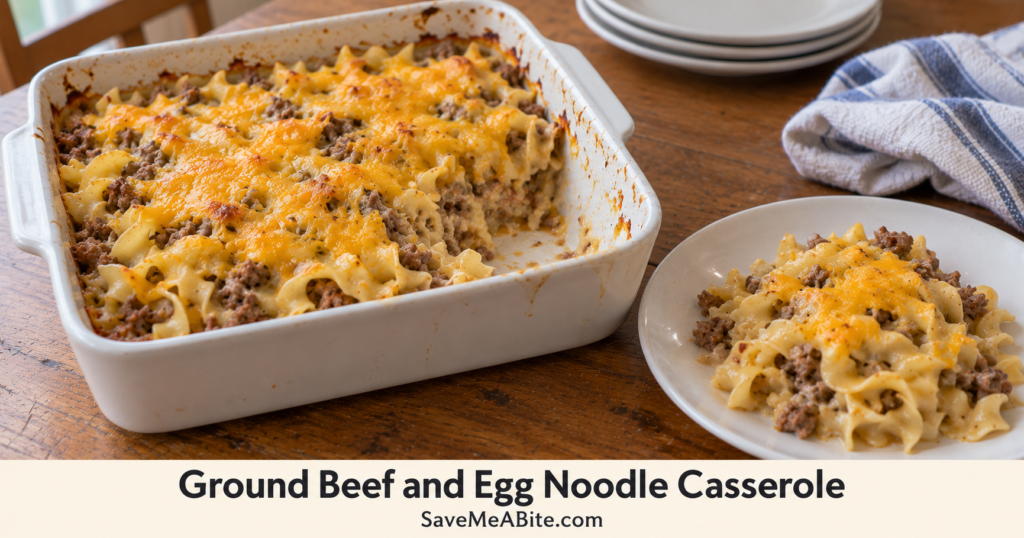
Cook and drain the noodles as directed. Extra cooking water carried into the dish can change the sauce, particularly in a small batch. For a recipe already proportioned for this dish size, use the 8×8 beef noodle casserole as a practical example.
Our ground beef and egg noodle casserole without canned soup is already written for an 8×8 dish, which takes the pan conversion out of the equation.
An 8×8 and a 9×9 Are Different Sizes Too
A 9×9 pan has 81 square inches of surface area. An 8×8 has 64.
That makes the 9×9 about 27% larger by area, even though each side is only one inch longer.
For the same amount of casserole, the 9×9 produces a shallower layer. In the 8×8, the filling sits deeper.
I would check capacity and filling depth before making that swap too. “Square pan” is not enough information to assume two dishes will behave the same way.
Check These Details Before the Pan Goes in the Oven
The conversion is more likely to work when you make the decisions before assembling dinner.
- Confirm the original recipe is intended for a 9×13 dish.
- Check that your 8×8 dish is suitable for the recipe’s oven temperature.
- Halve all ingredients, including sauce and topping.
- Keep cooked, dry, drained, and undrained instructions unchanged.
- Check that the filling leaves room for bubbling.
- Preserve the original covered and uncovered cooking method.
- Begin checking before the original finish time.
- Judge the center and ingredients using the recipe’s doneness guidance.
A smaller casserole should still look like the same dish. If it suddenly has twice as much sauce per noodle or a topping piled far deeper than the original, something probably was not scaled with the rest.
Questions About Using a Smaller Casserole Dish
Is an 8×8 pan exactly half a 9×13?
No. It has about 55% of the surface area.
Half a casserole recipe is often a practical amount for an 8×8, but the dish’s depth and the recipe’s cooking method still need attention.
Can I use a deep 8×8 dish without reducing the recipe?
I would not assume so. The mixture may fit, but the deeper filling can change heating time and texture.
Use a recipe written for that depth, reduce the batch, or divide it between suitable dishes.
Should I lower the oven temperature for the smaller pan?
I would generally keep the casserole recipe’s temperature when reducing the batch and keeping a comparable filling depth.
Changing the pan material introduces another variable. Follow any recipe-specific or manufacturer guidance rather than making an automatic temperature adjustment based only on size.
Can I double an 8×8 casserole for a 9×13?
Often, that is a useful starting point for a mixed casserole, but it is not an exact area match.
Twice the 8×8 area is 128 square inches, while a 9×13 has 117. The doubled mixture will sit somewhat deeper in a comparable 9×13 dish.
Check capacity, leave room for bubbling, and use doneness checks rather than assuming the original timing will hold.
What if I only need fewer servings but have a 9×13 dish?
A smaller batch in the larger dish will spread into a thinner layer unless the recipe provides a different arrangement.
That can change evaporation, browning, and baking time. I would use a smaller suitable dish when possible, especially for a casserole where keeping the filling moist matters.
Mara Whitcomb writes practical recipes and kitchen guides for Save Me a Bite.